Food labels can help you make informed choices by providing critical information, from nutritional content and ingredients to production practices. However, some companies use “fancy” words and obscure terms that lead to more confusion than clarity.
The effectiveness of food labels also depends on consumer understanding. For instance, you’ve probably bought juice drinks with a “no added sugar” claim, only to find out they were made from sugar-laden fruits, so additional sweeteners were unnecessary. Some terms are just open for interpretation.
To help you make healthier food choices, UPrinting shares some tips when reading the label claims (and fine print) on the packaging.
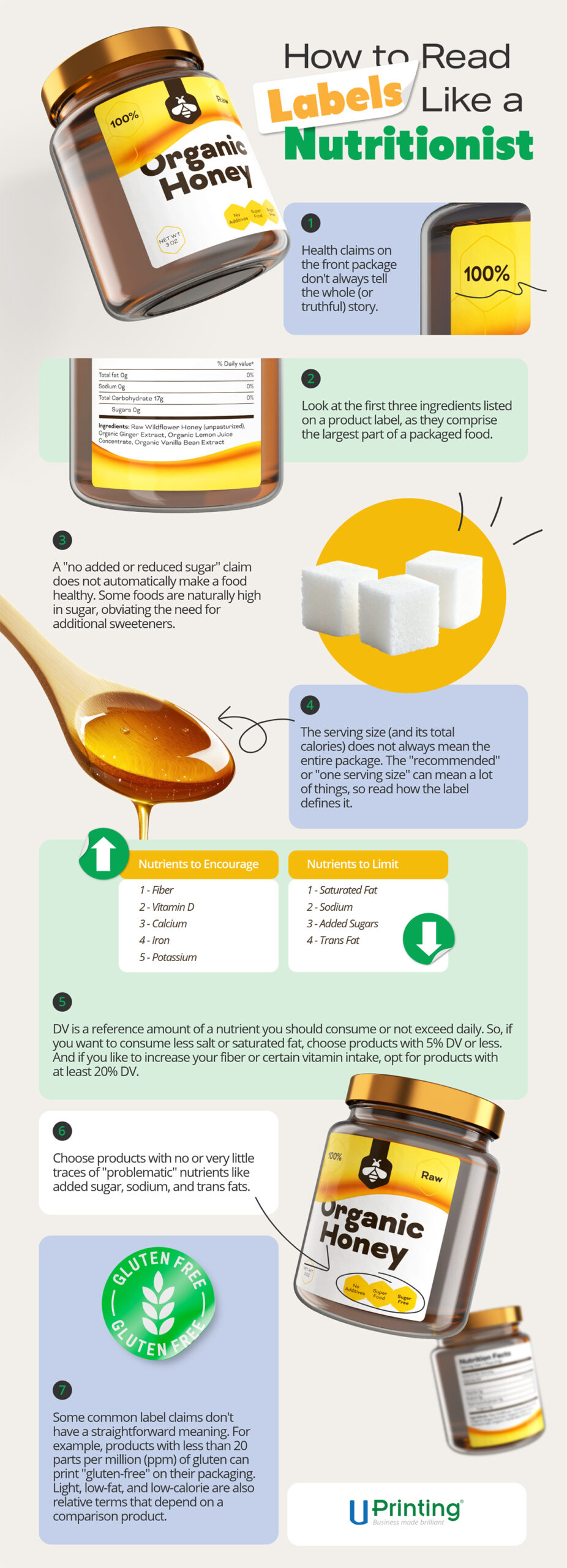
Treat health claims on the front packaging the same way you would treat a sweet talker you’ve just met at the bar: Ignore the persuasive language.
Think of the health claims on the front of the packaging as nothing but a distraction. What really matters is the ingredients list printed on the back.
Research shows that adding health claims to front labels makes consumers believe that a certain product is healthier than its exact version without health claims printed on the packaging.
So, the next time you see “whole grain” in a breakfast cereal box, take it with a grain of salt. It’s probably laden with sugar.
When you look at product labels, ingredients are listed by quantity, from highest to lowest. A good rule of thumb is to scan the first three ingredients, which comprise the largest part of a packaged food.
If the first three ingredients include whole or minimally processed foods, it’s a good indicator that the product is healthy. By contrast, foods with refined grains and hydrogenated oils mentioned on the top list can indicate that these are unhealthy or highly processed.
Another thing to keep in mind: An ingredients list that is longer than two to three lines typically suggests that the product is highly processed.
Sometimes, a complicated list of ingredients is not always the best (taste- and health-wise).
Even food companies that use accurate terms may still mislead customers. For instance, the label claim “no added sugar” could trick you into thinking a product is healthy, even though it is naturally high in sugar and does not need additional sweeteners.
Furthermore, some companies use fancy names for sugar that could inadvertently mislead consumers. Examples include agave nectar, maple syrup, fruit juice concentrates, barley malt, and evaporated cane juice. Many more names for sugar exist, but these are the most common.
Before you get excited about consuming the entire packet of cookies that claims to contain only 120 calories, think again. The calorie amount is probably based on the suggested serving size, say three out of 15 cookies. When it comes to food labels, the devil is in the details.
Further complicating things is that each company has its definition of suggested serving size. For example, one serving maybe half of a chocolate bar, a single biscuit in a pack, or a half can of fruit juice.
Some manufacturers also use serving sizes that are significantly smaller than people would typically consume in one sitting.
DV is a reference amount of a nutrient you should consume or not exceed daily. As a guideline based on a 2,000-calorie diet for healthy adults, it may not apply to everyone due to variables such as age, gender, activity level, and overall health.
Nevertheless, % DV can help you make healthier food choices. Say, if you want to consume less salt or saturated fat, choose products with 5% DV or less.
On the other hand, choose products with at least 20% DV (or more) if you want to consume more fiber or an essential vitamin or mineral.
Although it might be tempting to choose food items based primarily on price, health experts suggest that you should focus on buying products with the lowest amount of added sugar, sodium, saturated fat, trans fat, and other “problematic” nutrients.
However, you may need to avoid specific ingredients altogether if you have a certain medical condition. These ingredients may include artificial sweeteners, formaldehyde, and certain food additives.
First things first, not all seals and certifications are created equal, as some may be less rigorous than others.
Look for trusted food certifications recognized by retailers, consumer groups, and food service providers. Examples include Safe Quality Food (SQF) Program, Hazard Analysis Critical Control Point (HACCP), USDA Organic, and FSSC 22000, which ensure food safety, hygiene, and quality standards.
Some health claims on packaged food are designed to catch your attention and convince you that the product is a healthy choice, even though they are far from the truth.
Remember, deceit by “fancy words” and abstract terms is not uncommon in the food industry.
There are also common label claims that have a not-so-straightforward meaning.
Knowing the actual meaning of label claims on food packaging can help consumers like you make healthier choices.
Nevertheless, food brands are responsible for making their product labels accurate and easy to understand, which they can achieve using simple words rather than jargon and fancy language.
You can usually find the list of potential allergens in the “contains” statement near the ingredients list.
The USDA, FDA, and National Agriculture in the Classroom websites have information about food labeling and nutrition.
Some companies use highly technical terms in an effort to be as accurate as possible. For example, baking soda is also referred to as sodium bicarbonate.
No. Some foods are exempt from food labeling requirements in the US. These are vegetables, raw fruits, fish, fresh eggs, most dietary supplements, food processed and sold onsite, and small food packets.